 |
| After hearing the good news! |

Friday, May 10, 2013
Drum Major
Braxton was selected as one of Walton High's four drum majors for the 2013 season. It's something he has always wanted and worked so hard to get. Congratulations to him! Bill and I are proud parents!


Friday, May 3, 2013
Move Review - Argo
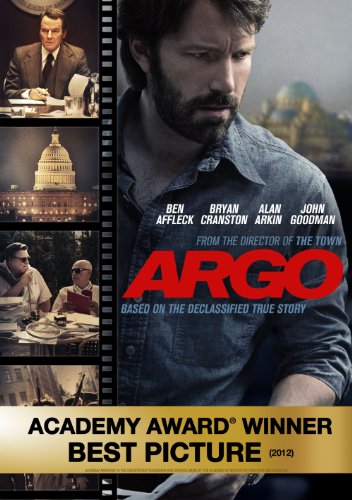
This year’s
Oscar winner for best picture is a much deserved production directed by Ben
Affleck, who incidentally was snubbed by the Academy in the category of Best
Director. But the film is a triumph, proving that his Oscar award-winning
script with Matt Damon for Good Will
Hunting was no fluke. He was only a boy then and has now proven to be a
very talented story teller.
I can see
why Hollywood honored this film, since two of its heroes are a sloppy make-up artist
(John Goodwin) and a hardened, crusty film producer (Alan Arkin - one of my
favorite actors). With a drab studio-lot office and a list of B movies on their
resume, they are no strangers to the dog-eat-dog world of film-making where
lying and scheming are the order of the day. Who could imagine that in 1979,
these less-than-honorable attributes would be just what the CIA needed to
rescue a handful of US diplomats trapped in the Canadian embassy after escaping
an angry mob in Tehran? Amazingly, this story is based in truth, having been
sealed to the public for decades. Now, years later, we have this wonderful movie
to share the events surrounding these unlikely heroes who helped save the lives
of six Americans.
The film
opens with dedicated diplomats busy at work in the US Embassy in Tehran, trying
their best to ignore an angry riot outside the building’s compound. But once
the wall is crossed, there’s nothing much security can do. It is edge-of-the-seat
action as everyone makes a mad scramble to destroy documents and get to safety before
the tide of fury pours in. Seeing the rage in the faces of those Iranian men
and women is a frightening scene, giving new meaning to the term “weeping and
gnashing of teeth.”
Not everyone
in the embassy is fortunate enough to escape, but six find refuge with the
Canadian Ambassador (Victor Garber) who keeps their location a secret. With
temporary safety secured, the US State Department explores rescue options, none
of which are viable given the tenuous political climate. Tony Mendez (played by
Affleck), a CIA exfiltration specialist, is consulted and surreptitiously comes
up with a bizarre, yet ingenious, plan. While on the phone with his little son,
an idea is hatched as they watch a favorite movie together—Battle for the Planet of the Apes. Mendez realizes the desert
setting is a perfect cover to convince the Iranian government he is a Canadian
filmmaker scouting exotic locations for his next sci-fi film. Now all the CIA
has to do is convince the fugitives to pass themselves off as a film crew and
then escape back to Canada without a hitch. Easier said than done.
Enter our Hollywood heroes, Goodman and Arkin,
who agree to help. They scan through a pile of old, rejected scripts and find
one entitled Argo, a science fantasy
in the vein of Star Wars. After
securing the rights, they set up a phony studio, plan script readings in full
costume and make-up, draw storyboards and marketing posters, and make
arrangements to go on a location scout with Mendez as producer. Meanwhile,
tensions escalate in the Canadian ambassador’s residence when it is discovered
the Iranian maid knows the truth. While she appears to be loyal, the fugitives suspect
their days of remaining hidden are numbered. Little do they know, but a large
group of Iranian women and children spend day and night piecing together
shredded documents like a gigantic jigsaw puzzle, soon discovering that six
diplomats are unaccounted for. With each passing day, they come that much
closer to recreating photographs of the fugitives.
The movie takes
off once Mendez travels to Iran with a fake ID, passport, and a visa to enter
the country as a Canadian film producer. Upon reaching Tehran, he takes up
residence with the Canadian Ambassador and preps the six diplomats on the escape
plan. As one might expect, they are frightened and unsure if they can actually
pull off convincing the Iranian authorizes they are a legitimate film crew. But
Mendez sees no other way. He doles out manila packages to each person, complete
with new names, identities, and bios, and encourages them to cooperate.
A trial-run
scouting visit to a crowded bazaar doesn’t go as planned, ending with their
pictures being snapped and Mendez narrowly whisking them to safety. This heightens
the fear even more, to the point where several of the fugitives refuse to
cooperate further, threatening to infect the group with dissension. To make
matters worse, Mendez is told by his US superiors that the mission is
terminated because of a planned military rescue of the hostages. But after a
series of threats and political finagling, he is successful in getting approval
to bring the diplomats home on Swissair.
*** SPOILER
ALERT ***
At this
point, fast-paced airport sequences take the movie from an exciting thriller to
an action film. First, the tickets don’t show up on the computer system until
the last second, security is frightening but eventually successful – Adam’s
apples are bobbing, sweat breaks out on the forehead, hands shake and eyes
flutter to and fro. As they near the gate and are almost ready to board the
plane, they encounter a group of bully military guards who scream Arabic at
them, harkening back to the horrible day when the angry crowd destroyed the
embassy. Mendez and his crew turn on the Hollywood charm by pitching their
movie, producing movie posters and storyboards, acting like seasoned veterans
of Tinsel Town. It works for a few moments, but then the guards insist on
calling North America to verify things.
On the other
side of the world, Goodman and Arkin stroll back to their studio-lot office,
not knowing who is telephoning at that very moment. As the phone rings and
rings, they are held up on a movie set, finally reaching the office and picking
up after what seemed like ten agonizing minutes. Goodman gives a good spiel and
the guards are satisfied. Mendez and the diplomats scurry out to the plane,
leaving their Argo paraphernalia behind
as peace offerings to the guards—all except one storyboard, which Mendez slips
into his bag.
But not so
fast—as the terminal doors close, the guards get a call stating that the
shredded documents have been pieced together and reveal the photo of one of the
escaped diplomats who posed as a film crew member that day in the bazaar. The
guards hustle into a jeep and chase the airplane as it taxis down the runway.
As Mendez looks out the window, the plane accelerates and lifts off, just as
the lead guard shakes his fist and gnashes his teeth. It is only when they
reach safe airspace that Mendez and the diplomats give a sigh of relief. At
last, they are free.
To protect
the hostages and other Americans at risk, the US’s involvement in the rescue
was suppressed and all credit given to Canada and its ambassador. Mendez was awarded
the Intelligence Star but had to return it until the information was
declassified in 1997. I can’t imagine holding something like that inside for so
many years, never being able to tell a soul, especially your family. Probably
why I don’t work for the CIA.
But there
are other ways to communicate truth, even if clandestine means are used. It’s
interesting how a good movie can be taken into the realm of greatness by one
little scene which evokes emotion from deep within the soul. I had no idea what
was raging within me as I watched this narrow escape take place. But here it
is: when Mendez returns home to his estranged wife and little boy, he produces
the one remaining storyboard and props it up on his son’s shelf along with all
the other sci-fi toys and gadgets. And for the first time, we see the picture
up close—it is the image of a Ben Affleck-looking man and a little sandy-haired
boy in a spaceship, narrowing escaping an attack from an evil desert empire.
Now how’s that for great storytelling? Loved it! That scene was like icing on
the cake for me.
Argo is a great movie
worthy of watching again and again to catch the many nuances of plot twists and
turns. Hopefully, Mr. Affleck will be directing more Oscar-worthy films to
come.
Sunday, April 21, 2013
My son, the Eagle Scout
.jpg) |
| Armed and dangerous! |
.jpg) |
| Finished product |
 |
| Before |
.jpg) |
| Buck - a lifesaver with all his tools! |
.jpg) |
| Snack table |
.jpg) |
| Dad |
.jpg) |
| Girl Power! |
.jpg) |
| Planning |
.jpg) |
| Riding the surf |
Monday, April 15, 2013
Mission Trip to the Dominican Republic

Tuesday, April 9, 2013
A Tribute to Roger Ebert
.jpg/250px-Roger_Ebert_crop_(retouched).jpg) |
| Roger Ebert circa 1970 - courtesy of Wikipedia |
Today, I am privileged to write a monthly column in christianfictiononlinemagazine.com where I am able to share my love for the movies--not unlike Siskel and Ebert. While my approach may be different, in that I only recommend and critique movies I like, the passion for story drives me in a similar way. Being in the film industry, I know how difficult it is to get a movie made, so I refuse to bash another's years of sacrifice, sweat, and toil. Statistics say the average time to get a film from script to screen is five years, but in my experience, that seems way too short!
Sadly, Gene Siskel died years ago, leaving Roger Ebert to go it alone. I didn't always agree with Ebert's critiques, but I embraced his gusto for story, character, conflict--buzz words in the screenwriting world. Hollywood (and especially independent filmmakers) can't help but appreciate the person who lives for the movies, waiting with great anticipation for the next film to be released, whether it be a drama, comedy, romance, horror, indie pic, noir, avant-garde, documentary, or silent film. Like a connoisseur of gourmet food or fine wine, Ebert was that person; he seemed to view films as a wonderful smorgasbord of fantasy and make-believe where one could tuck in for several hours and come away disgusted, complacent, bored, or satiated with excitement, but wanting more, regardless of the experience. He was a customer with refined tastes who didn't mind reveling in lowbrow every now and again, showing his true appreciation for the craft and art of film making. The industry will miss him (whether they care to admit it or not) as will the public.
With the growth of technology and the Internet, I don't know if Ebert's influence on the box office will be replaced, which may be a good thing. For me, his legacy isn't as a film cop who protected my hard earned money from bad movies, but rather the importance he gave to film in general. He legitimized my love for story and movies, making it a sophisticated topic of conversation for like-minded individuals labeled by some as "day-dreamers." Essentially, he brought movie making to the masses, presenting it as a craft to study and learn from, an art form that has the potential to move the soul, sway the heart, and conform the mind. He took movies seriously and made a living enjoying them, talking about them, and getting others to do likewise. What a wonderful and unusual gift he was given.
Tuesday, April 2, 2013
At the Movies - Lincoln
Several months ago, I saw Stephen
Spielberg’s Academy Award nominated, Lincoln,
but chose to wait until after Oscar night to give my review. Mainly, I wanted
to see if Daniel Day-Lewis made history by being the only man to win the prize
for Best Actor three times. With a splendid performance, complete with hunched
shoulders and spindly stature, Day-Lewis did make history. He gives a fresh
rendering of the great man, combining fragility with strength that made me
reaffirm Abraham Lincoln as my favorite US President.
The focus of the film is the period before
the close of the Civil War where Lincoln is in a political battle to secure the
end of slavery. It is the dilemma surrounding the ratification of the
Thirteenth Amendment that drives the story. National support is based on the
belief that the end of slavery will hasten the end of the war, but if peace is
negotiated, then that support might wane for fear of what a mass of free slaves
might do to an already weak economy. Lincoln realizes he has a short window of
time to garner support for the Amendment and have it ratified before the war
comes to a close. Others around him, both Confederate and Union, realize the
same thing, which sets up a political chess game that is quite enthralling. To
Lincoln, this is a game which must be won at all costs. In his opinion, slavery
must be cut off at the head, with absolutely no possibility of being
resurrected.
Immediately, our tall, lanky, somewhat
strange-looking sixteenth president becomes a hero with a mission. We know its
outcome, but the ride he takes is what entertains. The politics and lobbying
involved are fascinating and revealed my ignorance of American history. At
every turn, there is opposition that weighs heavily on Lincoln’s soul,
particularly from his wife, Mary Todd, who is played by Sally Field in one of
her best roles since Norma Rae.
Watching her rail on her husband, hurling one accusation after another,
feigning mental anguish and throwing child-like tantrums made me feel like the
world’s best wife. After reading about how much Lincoln adored her, despite her
mental instability, I gained even more respect for the man.
With the fate of the Amendment riding on
the House of Representatives, Lincoln launches a campaign to secure votes. He
hires three bumbling lobbyists (James Spader, John Hawkes, and Time Blake
Nelson) to solicit support from lame duck House members, promising cushy jobs
in the newly reformed government. Think The
Three Stooges stuck in the 1860s, minus Moe’s bowl haircut. My favorite was
Spader, who looked a little rounder and less handsome than what I remembered
from his ‘80 and ‘90s romance films. He added great humor to the movie which
lightened the intensity of the drama.
I’ll spare you the additional political intrigue, other than to say the foundation of the Amendment’s support lies with the movie’s most colorful character, Thaddeus Stevens (Tommy Lee Jones). Stevens is a radical, abolitionist member of the Republican Party whose tongue and wit are as sharp as the swords being swung on the battlefield. Watching him duel retorts with his opponents in the House is a wondrous sight to behold. How I would love to go back in time and be a fly on the wall, watching one of the most important battles in our history take place in the halls of the nation’s capital. The role couldn’t have been better cast than with Tommy Lee Jones. I believe he is one of America’s greatest actors.
I’ll spare you the additional political intrigue, other than to say the foundation of the Amendment’s support lies with the movie’s most colorful character, Thaddeus Stevens (Tommy Lee Jones). Stevens is a radical, abolitionist member of the Republican Party whose tongue and wit are as sharp as the swords being swung on the battlefield. Watching him duel retorts with his opponents in the House is a wondrous sight to behold. How I would love to go back in time and be a fly on the wall, watching one of the most important battles in our history take place in the halls of the nation’s capital. The role couldn’t have been better cast than with Tommy Lee Jones. I believe he is one of America’s greatest actors.
The best parts of the movie were the
gentle, tender moments with Lincoln’s little son, Tad. I teared up at seeing
the tired, worn-out head of state kneel to the floor and allow the sleepy boy
to climb on his back and head to bed after a long day. It provided a nice
glimpse of the human side of the loving father. Also, there were great jokes
and stories with deep philosophical morals that showcased the president’s
raconteur abilities and vast intellectual brain power. I don’t think I’ll ever
hear the term “Euclid’s Triangle” without seeing Daniel Day-Lewis wrapped in an
old blanket explaining the simple truths of life to two young soldiers.
The race to secure enough support in the
House builds to a nice climax, leaving the viewer on the edge of his or her
seat. Lincoln uses power, delays, intervention, and persuasion to succeed—by
just two votes. Finally, the Thirteenth Amendment is ratified and slavery ends,
with the war coming to a close several months later at Appomattox Court House.
But sadly, the end of the Civil War marks the end of one of our country’s
greatest leaders.
*** SPOILER ALERT ***
I wasn’t wild about the final scene where
Lincoln seemed to be deified as he delivered his second inaugural address. The
image of him being regaled as a god left me a little unsettled— he was a human
being with flaws like all of us. But overall the movie was emotional, informative,
and entertaining.
A final note: I loved how the filmmakers
threw in a very important social commentary toward the end of the movie that
still causes dissention amongst some old-line Southerners—interracial marriage.
When Thaddeus Stevens takes a copy of the ratified Amendment home, he presents
it to his black housekeeper, who turns out to be more than a cook and cleaner.
As he slips into bed, she is there next to him, referred to as his “darling.”
Very well-placed and strategic in its revelation of Steven’s character. Nicely
and cleverly done, Mr. Spielberg!
Subscribe to:
Posts (Atom)